Overview
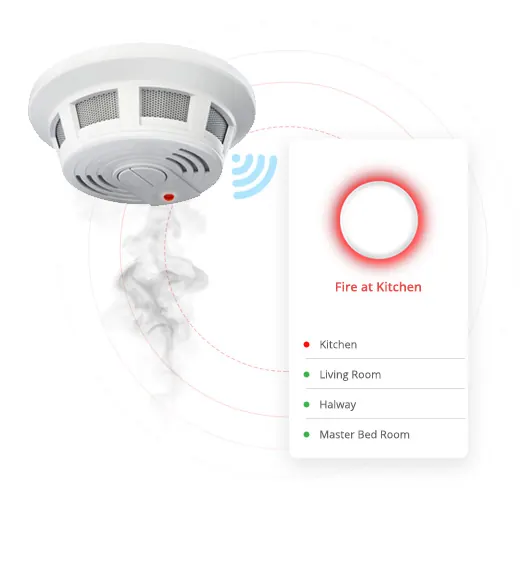
This engagement modernized a mission-critical fire alarm management app for a Hong Kong smart fire detection provider. The product sits inside a broader smart-city stack — conventional wired sensors, LoRaWAN wireless devices, and thermal cameras — and needed a stable, secure, IoT-ready mobile shell for building managers and on-call responders.
About the client
The client delivers smart fire detection across urban infrastructure. Their mobile app is how operators receive alarms, monitor device health, and coordinate response across mixed sensor fabrics.
Running on a deeply outdated React Native line blocked modern IoT protocols, raised security risk, and made every new building-management integration harder than it should be.
Their challenges
The legacy app could not keep pace with the sensor and building platforms around it. Modernization had to preserve operational continuity while unlocking IoT connectivity — on a two-week clock.
- 01
Outdated technology stack
React Native 0.7 lacked support for modern IoT protocols and smart-city APIs needed for current device fleets.
- 02
Security vulnerabilities
A legacy runtime exposed critical fire-safety workflows to known security risks.
- 03
Performance limitations
An inefficient codebase slowed real-time alarm monitoring when seconds matter.
- 04
Integration barriers
Hard to connect advanced LoRaWAN sensors and thermal camera systems into a single mobile experience.
- 05
Maintenance challenges
Deprecated APIs made ongoing development and fixes increasingly expensive and fragile.
- 06
Smart-city compatibility
Limited ability to integrate with modern building management and urban infrastructure platforms.
Our solutions
We treated the upgrade as a strategic modernization: migrate the runtime, harden security, restore performance for live alarms, and open the door to IoT and building-management integrations — without a multi-month rewrite.
Modern React Native architecture
Migrated from React Native 0.7 to 0.81 for performance, modern APIs, LoRaWAN/smart-sensor connectivity, and updated security protocols for fire-safety operations.
Enhanced IoT connectivity
Native-module updates for wireless fire sensors, thermal imaging, conventional wired alarms, and more robust IoT data handling.
Smart building management integration
Hooks into modern BMS and urban infrastructure systems with clearer incident notifications for responders.
Cross-platform optimization
Hardened iOS and Android builds, adaptive layouts, and improved offline behaviour for critical safety workflows.
Technology stack
The technology we used
- React Native 0.81
- Framework upgrade with modernized APIs and native modules.
- TypeScript
- Safer application code across critical fire-safety workflows.
- IoT fabric
- LoRaWAN sensors, thermal cameras, and conventional wired alarm integration.
- Redis
- Fast caching and session support for operational responsiveness.
- Docker
- Consistent build and release environments across platforms.
- CI/CD
- Automated testing and deployment for a two-week delivery window.
Key features built
What we delivered
| Capability | What we built |
|---|---|
| Legacy codebase migration | Deprecated API analysis, incremental migration with testing, compatibility layers for critical paths, and emergency rollback procedures. |
| IoT integration compatibility | Updated native modules, stronger sensor data processing, error handling, and live communication monitoring. |
| Performance optimization | Faster rendering for alarm monitoring, efficient IoT processing, and memory strategies for continuous operation. |
| Smart-city readiness | Foundation for urban fire-safety networks, building automation connectivity, and future platform expansion. |
Conclusion
The FireAlert modernization shows how a focused two-week engagement can unlock IoT and smart-city capability without sacrificing operational continuity on safety-critical mobile apps.
If your fire, building, or infrastructure ops app is stuck on a legacy mobile stack, the same playbook applies: upgrade the runtime, open the sensor layer, and ship with CI discipline.