Overview
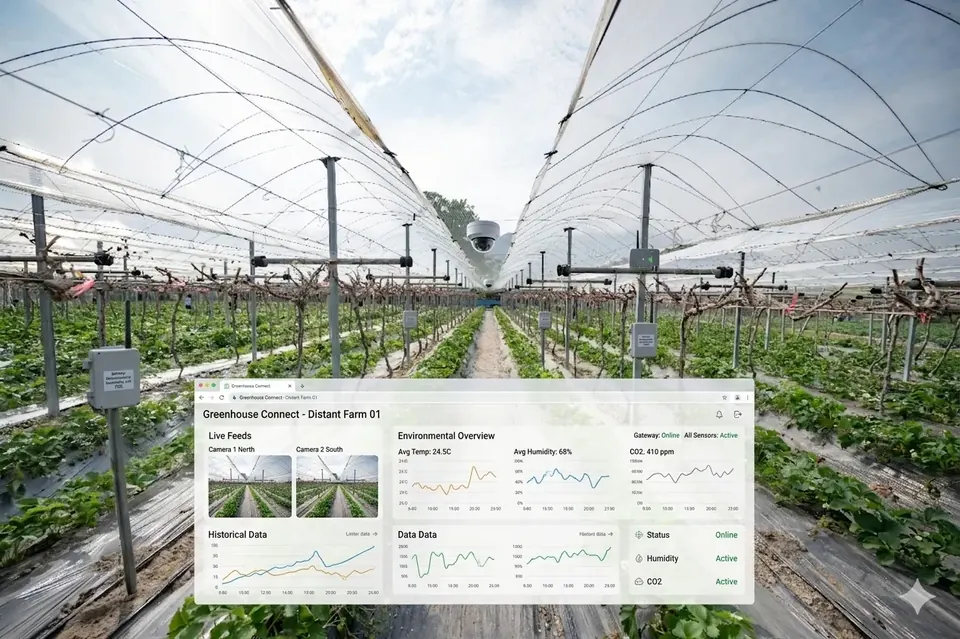
IoT Systems completed its first custom hardware-and-software installation at a high-tech greenhouse farm in Melaka dedicated to premium organic melons. Across a cluster of roughly forty houses, growers needed continuous visibility into both the canopy environment and the nutrient water feeding the crop — not spreadsheets and delayed spot checks.
About the client
The farm operates a dense greenhouse cluster focused on organic melon production, where small drifts in climate or fertigation chemistry quickly affect fruit quality, brix, and resource cost.
Operators needed real-time intelligence they could act on during the day — ambient conditions inside the houses, soil moisture, and the pH and EC of irrigation water — without adding complexity to already busy field routines.
Their challenges
Organic greenhouse melon production is unforgiving: climate swings stress plants, and imprecise fertigation wastes fertilizer while still risking underfeeding. The site needed a practical sensing layer matched to two jobs — in-house microclimate and tank-side water chemistry.
- 01
Invisible microclimate drift
Temperature, humidity, CO₂, light, and soil moisture can move outside the optimal band between manual checks — especially across a large multi-house cluster.
- 02
Fertigation guesswork
Without live pH and electrical conductivity (EC) on irrigation water, nutrient dosing tends toward waste or inconsistent crop response.
- 03
Scale without complexity
Growers needed actionable field telemetry, not another lab dashboard. The first install had to prove value quickly on a real working farm.
Our solutions
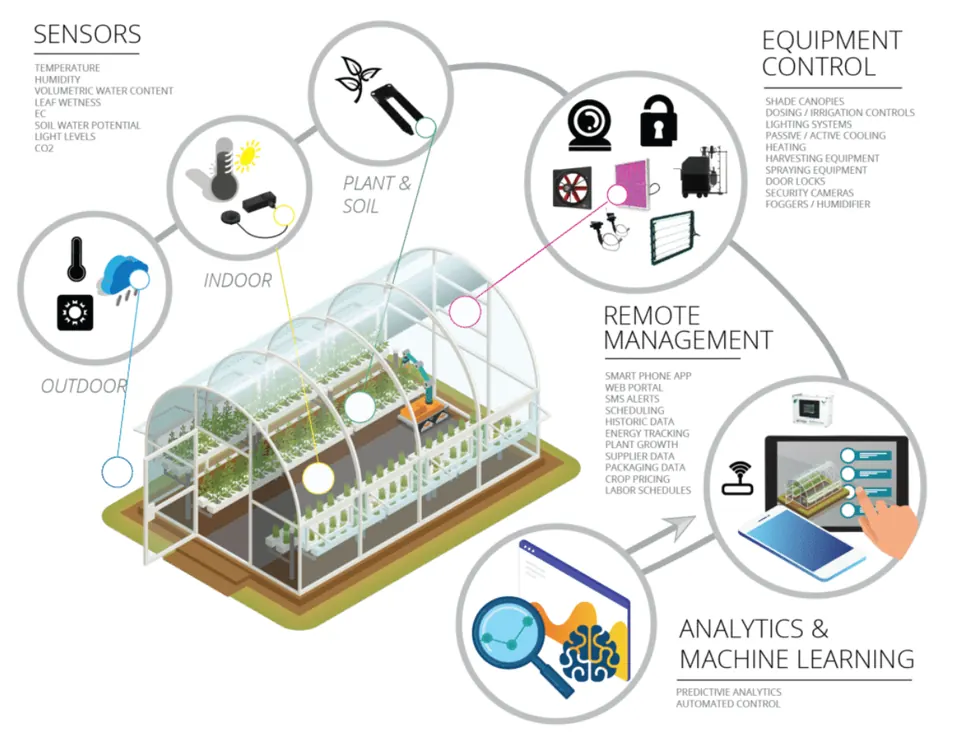
We deployed two specialized IoT control nodes tailored to the farm’s two operational planes: canopy and root-zone climate inside the greenhouse, and fertigation chemistry at the irrigation / water tank.
In-greenhouse environmental node
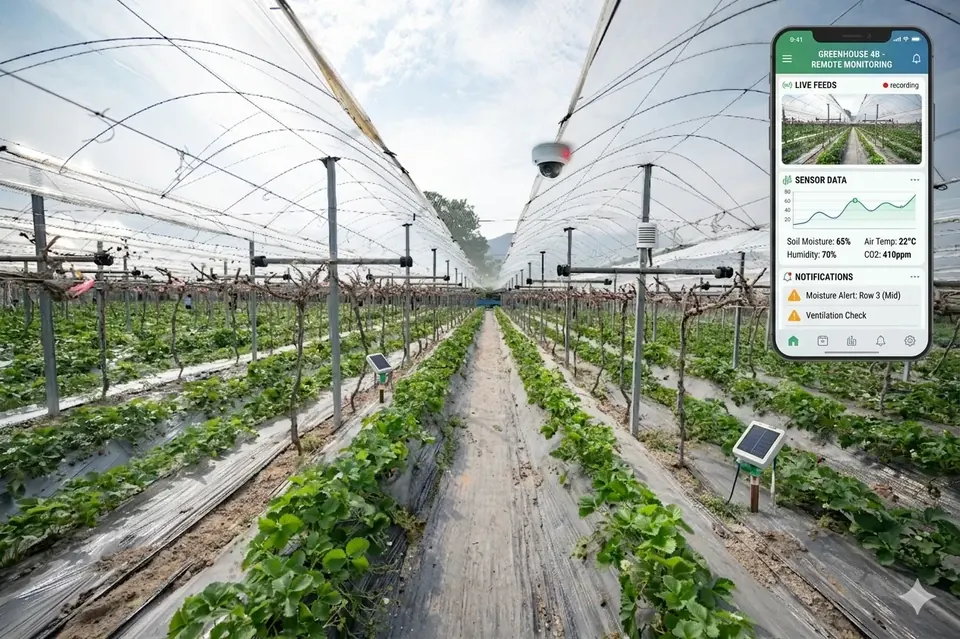
Monitors ambient temperature, relative humidity, CO₂, luminosity, and soil moisture — giving operators real-time microclimate intelligence so melons stay in their optimal growing band.
Irrigation & water tank node
Tracks water pH and electrical conductivity (EC) to deliver precise fertigation insight — crops get the nutrient balance they need, without over-dosing.
From guesswork to decisions
Combined environmental and water-nutrient tracking supports lower fertilizer cost, tighter water use, better yield quality, and day-to-day decisions grounded in live data.
Technology stack
The technology we used
- Custom IoT nodes
- Purpose-built field controllers for greenhouse and fertigation sensing.
- Climate sensing
- Temperature, RH, CO₂, and luminosity for canopy / ambient conditions.
- Soil moisture
- Root-zone hydration visibility for irrigation timing.
- pH / EC monitoring
- Tank-side water chemistry for precise fertigation.
- Field deployment
- Hardware live on a working organic melon greenhouse cluster in Melaka.
Key features built
What we delivered
| Capability | What we built |
|---|---|
| Microclimate intelligence | Live ambient and soil signals so operators can keep houses inside optimal growing windows. |
| Precise fertigation insight | pH and EC monitoring to reduce nutrient waste and stabilize crop feeding. |
| Water-use optimization | Soil moisture feedback that supports efficient irrigation schedules instead of fixed calendars alone. |
| Yield quality support | Stable CO₂, light, temperature, and nutrient balance to protect organic melon growth and brix potential. |
Conclusion
Seeing hardware live in Melaka — helping local growers scale sustainably — is the milestone that matters: not a lab demo, but a working farm with real organic melon production on the line.
The same pattern extends to other greenhouse and fertigation sites across the region: specialized nodes, clear operator signals, and decisions driven by live field data.